A plane mirror is a flat glass panel that reflects light and reshapes how a bathroom or hallway feels. This guide covers the most effective plane mirror styles—frameless, arched, round, LED backlit, and oversized—and explains how each choice affects light, sightlines, and everyday use. Whether you’re a homeowner or a designer, you’ll find clear sizing rules, placement tips, material trade-offs, and the 2024 trends in LED and smart mirrors. We also explain how custom fabrication and professional installation improve safety and fit, and where local custom services can help bring a project to completion. Read on for style rundowns, hallway placement tactics, a decision checklist with a sizing table, technical benefits of custom-cut mirrors, LED/smart feature comparisons, and real before-and-after examples to inspire your next mirror project.
What Are the Most Popular Bathroom Mirror Styles in 2024?
Mirror style combines shape, edge detail, and feature set. In 2024, homeowners and designers favor clean lines, built-in lighting, and shapes that balance softness with geometry. Frameless mirrors open tight rooms by removing visual boundaries, arched and round mirrors introduce softer silhouettes against angular fixtures, and LED backlit mirrors add reliable, adjustable task light. Together these choices create brighter, more flexible bathrooms that pair well with finishes like matte black and brushed brass. Below are the top styles and why they’re chosen for contemporary bathrooms.
Popular bathroom mirror styles and their defining benefits:
- Frameless Mirrors: Offer uninterrupted reflections that make small bathrooms feel larger and brighter.
- Arched & Round Mirrors: Introduce soft, sculptural shapes that balance rectilinear vanities and tiles.
- LED Backlit Mirrors: Merge illumination and reflection for clearer grooming and efficient ambient light.
- Oversized/Wall-to-Wall Mirrors: Maximize natural light and visually expand interiors for a dramatic, cohesive look.
Each style answers a different need—space enhancement, soft contrast, task lighting, or impactful scale—and those choices influence edgework and mounting. Next we dig into why frameless and curved shapes perform so well in modern bathrooms.
Which Frameless Bathroom Mirrors Enhance Space and Light?
Frameless mirrors are single glass panels finished with polished or beveled edges instead of a visible frame. By removing the frame, they extend the visual plane so walls read as farther away and light spreads more evenly—particularly useful in small or windowless baths. Most frameless installations use tempered mirror glass with polished edges for a refined look and better durability. Mounting options include mirror clips, Z-clips, and adhesive pads to achieve a near-flush appearance. When you choose frameless, specify a moisture-resistant backing and consider wall-to-wall spans for the biggest visual gain—details that set up the choice between curved and geometric shapes we cover next.
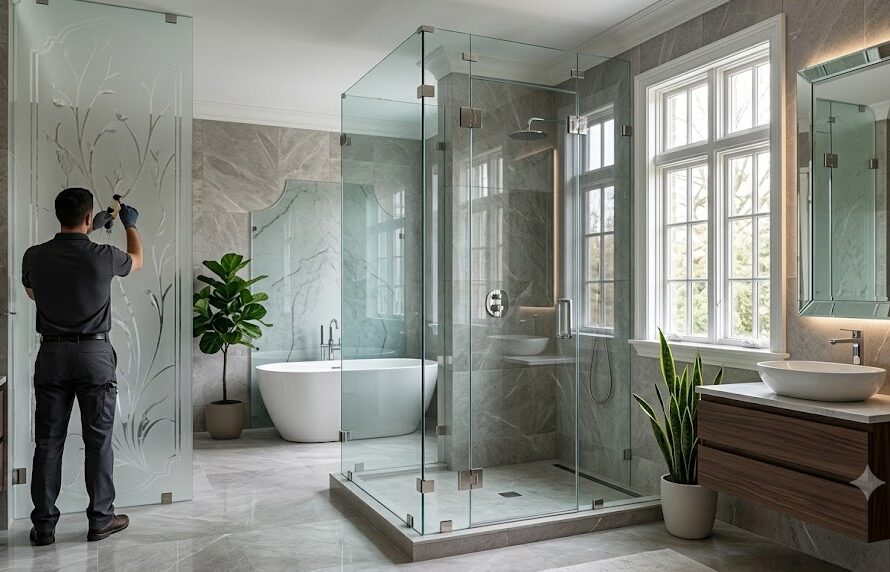
Modern bathrooms often pair mirrors with complementary elements like grid showers. These enclosures bring a clean, industrial edge that works well with minimalist mirror designs and strengthens the room’s architectural look.
How Do Arched and Round Mirrors Soften Bathroom Design?

Arched and round mirrors add curvature that offsets boxy vanities, linear tiles, and angular fixtures, creating a clear focal point above a sink or tub. Designers commonly use one large arch over a single vanity or paired curves over a double sink for rhythm and balance. For sizing, leave about 2–4 inches between the mirror edge and the vanity perimeter; thin metal rims or polished edges can define the shape without overpowering the composition. Those gentle shapes also translate well to hallway and full-length mirror choices, which we cover after this section.
Berwyn Glass Co. fabricates many of these popular styles—cut-to-size frameless panels, arched profiles, and integrated LED backlit mirrors—to match your exact dimensions. Our custom capabilities include precise edgework and tempered glass options so mirrors fit vanities or wall-to-wall runs without the usual DIY headaches. Local installation and trimming deliver a seamless final look.
How Can Hallway Mirrors Improve Decor and Space Perception?
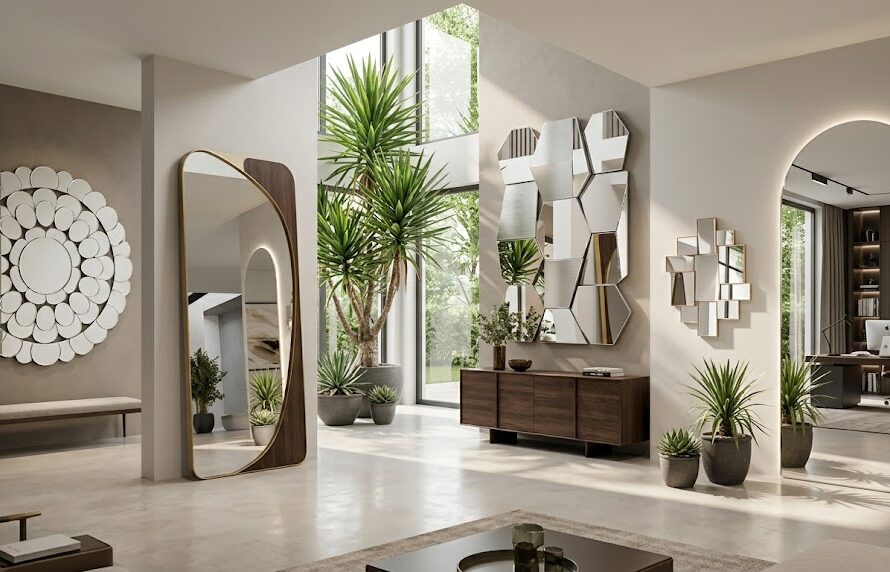
Hallway mirrors boost perceived depth, bounce daylight into interior corridors, and provide a quick pre-exit check. Placement and scale determine effectiveness: mirrors opposite windows redirect daylight down a corridor, while a mirror at the end of a hallway creates a convincing visual endpoint. Choosing between full-length, console-mounted, or decorative statement mirrors depends on hallway width, traffic, and nearby furniture. Below are practical benefits and placement tactics to make hallways feel brighter and more open.
Hallway mirrors deliver multiple practical benefits:
- Light Amplification: Mirrors opposite windows push natural light into otherwise dim corridors.
- Perceived Depth: A mirror at a hallway’s end visually extends the space.
- Functional Use: Full-length mirrors serve outfit checks; console mirrors anchor decor and create a drop zone.
These placement tactics guide mirror type and mounting decisions. Next we explain full-length options and how to scale console mirrors for balance.
What Are the Benefits of Full-Length Entryway Mirrors?
Full-length mirrors solve practical and spatial needs: they let you check an outfit head-to-toe and they reflect vertical lines that lengthen sightlines. For a built-in look use secure wall anchors; for a relaxed feel, a leaned mirror works well. Choose tempered glass and reinforced backing for safety in busy entryways. Typical sizing for most households is 60–72 inches tall so the mirror shows head-to-toe; leave room for trim and hardware to avoid a crowded appearance. These considerations help you decide between a built-in full-length panel or a framed leaning mirror—and how to size a console mirror to match.
Which Decorative Console Mirrors Add Style to Hallways?
Console mirrors act as focal points above entry tables or narrow consoles. Aim for a mirror width about two-thirds to three-quarters of the console to keep proportions balanced. Frame finishes—matte black for contrast, brushed brass for warmth, or wood for a softer look—set the hallway’s mood. Choose moisture- and abrasion-resistant finishes where furniture sees frequent use. Pair a console mirror with low-profile lighting and minimal accessories to avoid clutter; the mirror should both reflect light and anchor the vignette. These style choices naturally lead into sizing and material trade-offs for bathrooms and hallways, covered below.
When space is tight in a bathroom, consider efficient options like sliding showers. These layouts free floor space much like a strategically placed mirror visually expands a compact room.
How to Choose the Right Plane Mirror for Your Bathroom or Hallway?
Picking the right plane mirror in gladwyne means matching room type, function, and materials so the mirror performs and looks right over time. Size, mounting, and finish matter in humid bathrooms and narrow hallways.
A quick checklist for choosing a mirror:
- Measure First: Record vanity width, wall height, and clearance from fixtures to set correct proportions.
- Match Function: Choose full-length for outfits, LED backlit for grooming, and frameless for visual expansion.
- Pick Materials: Specify tempered glass, corrosion-resistant backing, and moisture-rated frames for bathrooms.
This checklist keeps safety and performance front of mind before fabrication and installation. The table below links common rooms to recommended shapes and sizes to simplify your selection.
Intro to sizing and placement table: the table maps common spaces to mirror shapes and size guidance to simplify selection.
| Space Type | Recommended Shape | Recommended Size |
|---|---|---|
| Single vanity bathroom | Rectangular or arched | Width ~70–90% of vanity; height 30–36 in typical vanity zone |
| Double vanity bathroom | Long horizontal or paired mirrors | Two mirrors each 60–80% of each sink zone or one spanning mirror with centered light |
| Narrow hallway | Tall, narrow full-length | Height 72–84 in; width proportional to wall (20–36 in) |
| Small powder room | Round or small rectangle | Diameter 20–30 in or width 24–30 in to avoid overwhelming space |
| Entryway with console | Round/oval over console | Width 2/3 of console table; leave 4–8 in clearance above table |
This sizing guide links room types to practical shape and size recommendations. Below we compare frame styles and finishes to help finalize the aesthetic.
Berwyn Glass Co. offers in-home measurement services and measurement guidance to confirm the exact dimensions above. Our team provides custom cutting and edgework advice for tempered panels so you avoid ordering mistakes and get a mirror that aligns with plumbing, lighting, and tile layouts.
What Size and Shape Best Fit Different Bathroom and Hallway Spaces?
Size and shape follow simple proportion rules: mirror width should relate to furniture or wall length; orientation depends on sightlines and traffic. A useful rule is 70–90% of vanity width for single vanities and equal spacing for double sinks. In narrow hallways, a tall panel maximizes reflected depth. Shape also dictates mood—round mirrors soften industrial fittings; rectangular mirrors reinforce linear tiles. Proper placement relative to lighting ensures the mirror works as intended. These decisions inform edgework, framing, and material choices covered next.
How Do Frame Styles and Finishes Affect Mirror Aesthetics?
Frames are small-scale architecture for your mirror: finishes like matte black, brushed brass, or warm wood shift a room from modern to transitional or rustic. Frame materials differ in moisture resistance—powder-coated metal and sealed wood hold up better in humid bathrooms than unfinished wood—so balance appearance with longevity. Frameless mirrors remove the frame entirely, relying on beveling or polished edges for a finished look. Knowing these trade-offs makes it easier to choose custom options and installation methods handled by fabricators and installers.
What Are the Advantages of Custom Cut Mirrors from Berwyn Glass Co.?

Custom-cut mirrors are produced to exact dimensions, edge profiles, and integrated features—like LED channels—offering a better fit, greater safety, and a cleaner look than off-the-shelf options. Custom fabrication delivers a seamless fit around vanities, in niches, or on irregular walls and allows for tempered glass, specialized backing, and built-in lighting. Benefits include improved durability, smaller installation gaps, and design flexibility that standard retail mirrors can’t match. Below we summarize Berwyn Glass Co.’s core strengths and the homeowner outcomes they enable.
Key custom advantages from local fabrication:
- Precision Fit: Custom panels remove awkward gaps and eliminate on-site patching.
- Safety & Durability: Tempered glass options increase shatter-resistance for wet and high-traffic areas.
- Integrated Features: Built-in LED channels and anti-fog options are finished during fabrication for a tidy installation.
These advantages lower long-term maintenance and produce a polished result. The table below shows how custom attributes translate into homeowner benefits.
| Custom Element | Attribute | Benefit/Outcome |
|---|---|---|
| Cut-to-size panels | Exact dimensions and edgework | Seamless fit with minimal finishing at installation |
| Tempered mirror glass | Heat-treated safety glass | Shatter-resistant, code-friendly for high-traffic areas |
| LED integration | Built-in lighting channels and driver placement | Cleaner wiring and uniform light without aftermarket mods |
| Moisture-rated backing | Corrosion-resistant mirror backing | Longer life in humid bathrooms and fewer replacement needs |
This comparison shows why custom fabrication is the smart choice for irregular walls, integrated lighting, or high-use areas. Next we outline the fabrication and installation process so you know what to expect.
How Does the Custom Mirror Fabrication and Installation Process Work?
Fabrication starts with an on-site consultation and precise measurements. From there we cut the glass, finish edges, apply moisture-resistant backing, and integrate features like LED drivers or anti-fog coatings. The shop cuts tempered mirror glass to the specified profile, polishes or bevels edges, bonds backing, and prepares mounting hardware tailored to the installation plan. Installation includes surface prep, secure anchoring or Z-clip mounting, and final alignment so the mirror sits flush and gap-free. Typical lead times range from a few days to several weeks depending on complexity—knowing this process helps you schedule contractors and plan timelines.
Why Choose Tempered Glass and Quality Materials for Safety and Durability?
Tempered glass is heat-treated so it’s stronger than regular glass and breaks into small, less-dangerous pieces rather than sharp shards—an important safety feature for bathrooms and entryways. That safety profile also aligns with building code recommendations for areas near doors, tubs, or high-traffic zones. Quality backing and edge finishes prevent delamination, spotting, and corrosion in humid conditions, extending mirror life and reducing replacements. Choosing these materials up front minimizes long-term service calls and preserves the installed appearance, which ties into LED and smart feature considerations below.
Berwyn Glass Co. emphasizes precision installation and durable materials—tempered glass and custom finishes—across our mirror offerings. We serve Phoenixville, Ardmore, Gladwyne, and West Chester with on-site consultations so homeowners can get accurate estimates and confident timelines.
What Are the Latest Trends in LED and Smart Bathroom Mirrors?
In 2024, LED and smart mirrors focus on integrated illumination, reliable anti-fog solutions, and simple controls that favor energy efficiency and everyday convenience. Matte black frames and minimalist edge profiles are stylistic favorites. Integrated LEDs deliver consistent, color-correct task light; anti-fog modules keep the mirror usable after a hot shower; and features like dimming, memory presets, and Bluetooth audio appear on higher-end models. These options improve grooming accuracy, reduce the need for extra fixtures, and support energy-conscious homes. The table below compares common LED and smart features with practical benefits.
| Feature | Characteristic | Practical Benefit |
|---|---|---|
| Edge-lit LED | Slim, even illumination from glass edge | Uniform task light without bulky frames |
| Backlit LED | Light source behind mirror surface | Ambient glow and halo effect for mood lighting |
| Anti-fog | Integrated heating or hydrophobic coatings | Clear reflection after steam exposure |
| Touch/dim controls | Capacitive or button interfaces | Adjustable light levels for different tasks |
| Smart integration | Bluetooth, voice-enabled modules | Media playback and hands-free control in the bathroom |
This feature-to-benefit mapping shows how LED and smart options boost everyday use and complement design choices. Next we look at how LED backlit and anti-fog mirrors work in practice.
How Do LED Backlit and Anti-Fog Mirrors Enhance Bathroom Functionality?
LED backlit mirrors deliver soft, even illumination that reduces facial shadows and improves tasks like shaving and makeup application by providing neutral, color-correct light. Anti-fog systems—either low-wattage heating elements or hydrophobic coatings—prevent condensation so the mirror is ready right after a shower. Installation planning should include power routing and driver placement; drivers can be recessed behind a cabinet or mounted nearby to keep hardware out of sight. Energy-efficient LEDs also keep operating costs low. Addressing these installation needs early ensures reliable performance and cleaner integration with cabinetry and tile.
What Smart Mirror Features Are Popular in 2024 Designs?
Popular smart mirror features include Bluetooth audio, dimming presets, integrated clocks, and basic voice control—useful when you want a single interface for morning routines. The trade-offs are higher cost and more complex installation—smart functions can require extra wiring or an outlet—but they add convenience and future readiness. For many homeowners, a well-specified LED backlit mirror with dimming covers most needs without the expense or complexity of full smart integration. Your choice depends on budget, desired features, and willingness to plan electrical work during installation.
How Can Custom Mirrors Transform Your Bathroom and Hallway Spaces?
Custom mirrors change a room by matching scale, integrating light, and aligning finishes with existing hardware. Measurable outcomes include more perceived room size, better lighting quality, and a cohesive visual story. A custom wall-to-wall mirror can make a small powder room feel larger and brighter; a full-length panel can turn a narrow hallway into a luminous passage. Below are typical transformation outcomes and design strategies that show how tailored mirrors enhance both function and perception.
Transformation outcomes homeowners commonly see:
- More Light: Custom mirrors amplify windows and fixtures, noticeably brightening interiors.
- Perceived Spaciousness: Wall-to-wall or full-length installations create an illusion of larger rooms.
- Cohesive Style: Matched edgework and frame finishes tie mirrors to fixtures and furniture for a unified look.
What Are Real Examples of Bathroom Mirror Transformations?
Common successes include replacing several small mirrors in a windowless bathroom with a single frameless wall-to-wall panel, which increases reflected daylight and removes visual interruptions. Another example swaps mismatched framed mirrors over a double vanity for two arched custom panels with integrated LED lighting—resulting in symmetry, better task light, and a more refined finish. These case examples follow the same process: identify the functional gap, apply a tailored mirror solution, and measure outcomes like improved light and perceived space. Seeing these results helps homeowners picture the value of custom mirrors.
How Do Hallway Mirrors Create the Illusion of Space and Light?
Hallway mirrors extend sightlines by reflecting focal points—windows, artwork, or an end wall—so corridors read as deeper and brighter. Positioning a mirror across from a window multiplies daylight; placing one at the end of a corridor gives a convincing sense of added distance. Choose frameless panels for a subtle expansion or decorative frames for a focal accent depending on the hallway’s purpose and decor. These placement and style strategies complete the path from inspiration to installation and point to consulting a local fabricator for a precise fit.
Berwyn Glass Co. offers custom mirror consultations and professional installation across Phoenixville, Ardmore, Gladwyne, and West Chester. If you’re ready to explore custom options, we can measure your space, recommend tempered glass and edgework, and provide a firm estimate for fabrication and installation—visit our mirrors hub and installation service pages for scheduling details.
Frequently Asked Questions
1. What factors should I consider when choosing a mirror for a small bathroom?
For a small bathroom focus on size, shape, and mounting. A frameless or wall-to-wall mirror removes visual boundaries and makes the room feel larger. Keep mirror proportions roughly 70–90% of the vanity width and pick a mounting method—flush mounts read cleaner and less crowded. Also prioritize moisture-rated materials to avoid premature deterioration.
2. How can I maintain the clarity and appearance of my bathroom mirror?
Clean mirrors regularly with a gentle glass cleaner and a microfiber cloth to avoid scratches. Avoid abrasive pads or harsh chemicals. Good ventilation reduces moisture buildup that leads to fogging or spotting; if your mirror has anti-fog features, check them periodically to ensure they’re functioning.
3. Are there specific lighting considerations for mirrors in bathrooms?
Yes—lighting is key. Use LED fixtures that offer even, shadow-free illumination. Position lights at face level or choose an LED backlit mirror rather than relying only on an overhead light. Aim for color temperatures in the 3000K–4000K range for accurate color rendering, and consider dimming for flexible ambiance.
4. What are the advantages of using LED backlit mirrors?
LED backlit mirrors produce even, flattering light for grooming, add ambient illumination, and create a clean modern look. LEDs are energy-efficient and long-lasting, and many models include dimming and anti-fog options for extra convenience. Built-in lighting also keeps the overall design streamlined.
5. How do I ensure my custom mirror fits perfectly in my space?
Start with accurate measurements of height, width, and nearby fixtures. If walls aren’t perfectly straight, schedule a professional site measurement. Discuss edge profiles, backing, and mounting with your fabricator and confirm installation details to prevent surprises during setup.
6. What are the latest trends in mirror design for 2024?
Trend highlights for 2024 include minimal profiles, integrated LED lighting, and smart features. Frameless and arched mirrors remain popular for their clean, calming silhouettes, while LED backlit mirrors deliver function and style. Smart features—Bluetooth, touch controls, presets—are growing but remain optional for most homeowners.
7. Can I install a mirror myself, or should I hire a professional?
Small, straightforward mirrors can be a DIY project, but we recommend hiring a pro for large or custom mirrors—especially those with integrated lighting. Professionals ensure correct mounting, secure anchors, and safe electrical connections when required. If you choose DIY, follow manufacturer instructions and use the proper tools and hardware.
Conclusion
The right plane mirror can change how a bathroom or hallway looks and functions—bringing more light, a greater sense of space, and a cohesive finishing touch. Understanding styles, materials, and custom options helps you make choices that last. When you’re ready to move from idea to installation, Berwyn Glass Co. offers expert consultations, precise fabrication, and professional installation to bring your project to life. Explore our services to start planning a custom mirror that fits your space and your style.