When planning a bathroom renovation, one question comes up again and again: shower glass vs shower door — are they the same thing, or is there a meaningful difference? It’s a fair question, and the confusion is understandable. The two terms are often used interchangeably in showrooms and online guides, but they actually refer to different concepts within your shower setup. Understanding the distinction can save you money, help you choose the right product for your bathroom, and ensure you get the look and function you’re after.
At Berwyn Glass, we work with homeowners and contractors every day who come in looking for one thing and leave with a much clearer picture of what they actually need. This guide breaks down the shower glass vs shower door debate once and for all — covering glass shower door types, frameless options, shower enclosure styles, and how to match your shower opening options to your bathroom layout.
What Is Shower Glass? Understanding the Term
“Shower glass” is a broad term. It refers to any glass panel or series of panels used within a shower space — whether that glass moves, swings, slides, or stays completely fixed. In other words, shower glass is the material and structural category, not a single product type.
A shower glass panel, for example, might be a static fixed screen installed beside a shower tray with no door at all. In a walk-in shower design, the glass simply acts as a splash barrier, angled or positioned to keep water contained while leaving the entry completely open. There’s no hinged frame, no handle, and no moving part — just a clean expanse of glass.
This type of setup is increasingly popular in modern bathroom design, especially in larger bathrooms where a fully open shower entrance suits the layout. The glass itself is typically toughened (also called tempered) safety glass, measuring anywhere from 6mm to 10mm thick depending on the application.
So when someone says “I want shower glass,” they might mean a panel, a screen, an enclosure, or a door. The term covers all of it — which is precisely why the shower glass vs shower door question comes up in the first place.
What Is a Shower Door? Narrowing the Definition
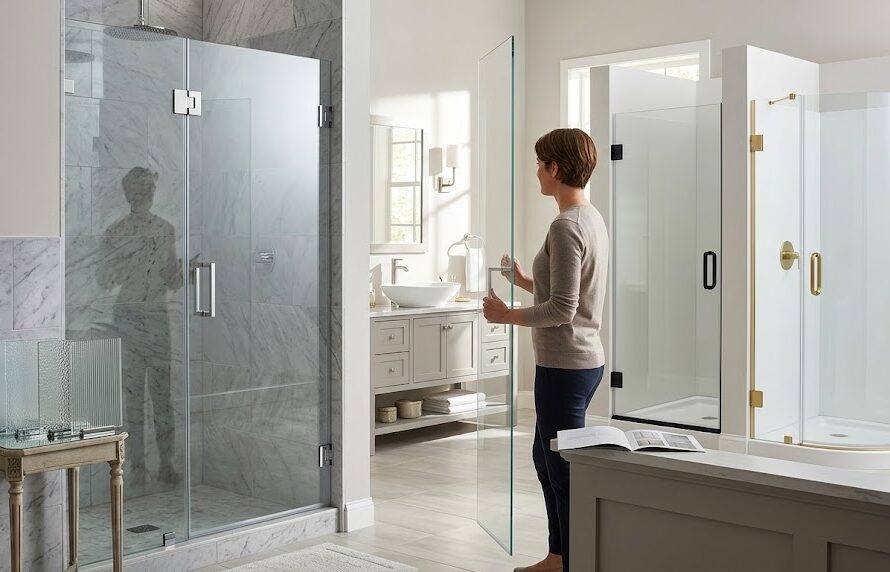
A shower door is a specific type of shower glass. It’s the moving element — the part of your shower setup that opens and closes to allow entry. Shower doors are fitted within a frame or hung from a track, and they come in several configurations depending on your bathroom size, shape, and personal preference.
Here are the main glass shower door types you’ll encounter:
1. Hinged Shower Doors
The most traditional option. A hinged door swings outward (or in both directions) on pivot hinges fixed to a wall or to a fixed glass panel. These work best in bathrooms with enough clear floor space in front of the shower to accommodate the swing. They offer a wide, unobstructed entry point and are available in both framed and frameless styles.
2. Sliding Shower Doors
Sliding doors run along a top track (and sometimes a bottom track) and glide horizontally across the shower opening. Because they don’t require swing clearance, they’re ideal for smaller bathrooms or alcove shower setups. They’re a common choice in family bathrooms where practicality takes priority.
3. Bifold Shower Doors
Bifold doors fold inward like a concertina, making them one of the most space-efficient shower opening options available. They suit compact en-suites and smaller shower enclosures where neither a hinged nor sliding door would work comfortably.
4. Pivot Shower Doors
Similar to hinged doors but mounted on a central pivot point, allowing the door to swing in and out. Pivot doors often have a more minimal aesthetic and work particularly well with frameless glass.
5. Walk-In Panels with No Door
Increasingly, homeowners are choosing walk-in configurations with no door at all — just a strategically placed shower glass panel or L-shaped screen. This sits at the crossroads of the shower glass vs shower door discussion: there’s glass, but there’s no door.
Shower Glass vs Shower Door: The Core Differences
Now that both terms are defined, here’s a direct comparison across the key factors that matter when choosing:
Function
Shower glass encompasses all glazing within the shower space, including fixed panels, side returns, and overhead canopies. A shower door is specifically the access point — the element that opens and closes. You can have shower glass without a shower door (in a walk-in setup), but you cannot have a shower door without shower glass.
Design Flexibility
Fixed shower glass panels offer the cleanest, most minimal look. There are no hinges, handles, or frames to interrupt the sightline, which makes the bathroom feel larger and easier to clean. A frameless shower glass panel or enclosure achieves this effect particularly well.
Shower doors introduce hardware into the equation — handles, hinges, tracks — which can either complement your bathroom fittings or, if chosen carelessly, clash with them. High-quality frameless shower doors minimise this issue, but the hardware is still present.
Maintenance
Fixed shower glass panels are generally easier to maintain because there are fewer joints, seals, and moving parts where mould and limescale can accumulate. Shower doors — especially sliding doors with bottom tracks — require more regular cleaning to keep running smoothly and looking good.
Space Requirements
The shower screen vs door comparison often comes down to space. A walk-in panel or fixed screen requires no swing clearance and can fit into almost any bathroom configuration. Hinged and pivot doors need clearance in front of the shower — a practical constraint that rules them out in tighter bathrooms.
Watertightness
This is where doors have an edge. A properly fitted shower door with good seals will contain water more effectively than a walk-in panel. Open walk-in configurations rely on the correct positioning of the glass panel and good shower head placement to avoid water escaping. If your shower has a powerful rainfall head or a handheld attachment used freely, a door will keep your bathroom floor drier.
Shower Enclosure vs Door: Which Is Right for You?
The shower enclosure vs door question is another way of asking whether you want a contained system or a more open arrangement.
A shower enclosure is a complete unit — four sides of glass (or three, with one being a tiled wall) that fully enclose the shower area with a door as the entry point. Enclosures are the more traditional choice and remain popular in family bathrooms and homes where water containment is a priority.
A door-only configuration — where the shower is set into an alcove and a single door panel covers the opening — is simpler, more affordable, and easier to install. It’s the most common setup in standard bathrooms.
Walk-in glass panels sit at the other end of the spectrum: no enclosure, no door, just well-positioned glass and smart shower design.
Here’s a quick way to decide:
- Choose a shower enclosure if your bathroom is small, if you have young children, or if water containment is a top concern.
- Choose a shower door only if your shower is in an alcove or recess and you want a cost-effective, practical setup.
- Choose a walk-in glass panel if you have a larger bathroom, prefer a minimal aesthetic, and want easy, frameless access.
Frameless vs Framed: A Detail That Changes Everything
One of the most important decisions within the shower glass explained conversation is whether to go framed or frameless — and it applies to both panels and doors.
Framed shower glass uses a metal frame (typically aluminium) around the perimeter of the glass and along the edges of the door. It’s strong, affordable, and provides a clear visual boundary. The downside is that the frame collects soap scum and limescale, and it gives the bathroom a more utilitarian feel.
Frameless shower glass uses thicker glass (usually 8mm to 10mm) supported by minimal fixings — wall channels, hinges, and small clamps rather than a continuous frame. The result is a much cleaner, more luxurious look that opens up the bathroom visually. Frameless options are more expensive, but they are significantly easier to clean and have a timeless quality that suits both contemporary and classic interiors.
At Berwyn Glass, our frameless shower glass range is one of our most popular product categories. Homeowners consistently tell us that once they see a frameless panel or door fitted in their bathroom, they can’t imagine going back to framed.
Semi-frameless options — where the door is frameless but the surrounding structure uses minimal framing — offer a middle ground between cost and aesthetics.
Glass Types and Safety Considerations
Regardless of whether you choose a shower door or a fixed glass panel, the glass itself must meet safety standards. In the UK, all shower glass must comply with BS EN 12150 (for toughened glass) or BS EN 14449 (for laminated glass). Both types are designed to break into small, relatively harmless pieces rather than dangerous shards.
Toughened glass is the standard choice for most shower applications. It’s strong, thermally resistant, and available with easy-clean coatings that repel water and reduce mineral buildup — a practical upgrade worth considering if you’re in a hard water area.
Low-iron glass is another option worth knowing about. Standard glass has a slight green tint that becomes more visible in thicker panels. Low-iron glass has a clearer, more neutral appearance, which makes it the premium choice for frameless shower enclosures where the glass itself is the visual focal point.
How Berwyn Glass Can Help
Navigating shower glass explained in full — panels, doors, enclosures, frameless options, glass types, and installation requirements — is exactly what the team at Berwyn Glass is here for. We supply and install bespoke shower glass across a wide range of styles and budgets, working with homeowners, interior designers, and trade contractors.
Whether you’re looking for a single frameless glass panel for a walk-in configuration, a complete shower enclosure with a pivot door, or advice on the right glass type and thickness for your specific layout, we’ll help you make the right call.
Our approach is straightforward: we listen to what you need, look at your space, and recommend the product that does the job properly — not the most expensive option, and not a compromise.
Summary: Shower Glass vs Shower Door at a Glance
| Feature | Shower Glass (Panel/Screen) | Shower Door |
|---|---|---|
| Definition | Any glass used in a shower space | The moving access element specifically |
| Door required? | No | Yes, by definition |
| Best for | Walk-in, open layouts | Alcoves, enclosures |
| Maintenance | Lower (fewer joints) | Moderate to higher |
| Space needed | Minimal | Requires swing/slide clearance |
| Aesthetic | Clean, minimal | Varies by style |
| Frameless option | Yes | Yes |
Final Thoughts
The shower glass vs shower door question doesn’t have one universal answer — the right choice depends on your bathroom size, your lifestyle, your budget, and the look you’re going for. What’s important is understanding that these aren’t competing products; they’re different elements of the same shower system, and in many cases, you’ll need both.
If you’re planning a bathroom renovation and want clear, honest guidance on your options, get in touch with Berwyn Glass. We’ll help you understand exactly what you need — and make sure what you choose looks great and works properly for years to come.